+ Designing climate-responsive architecture
with lasting performance.
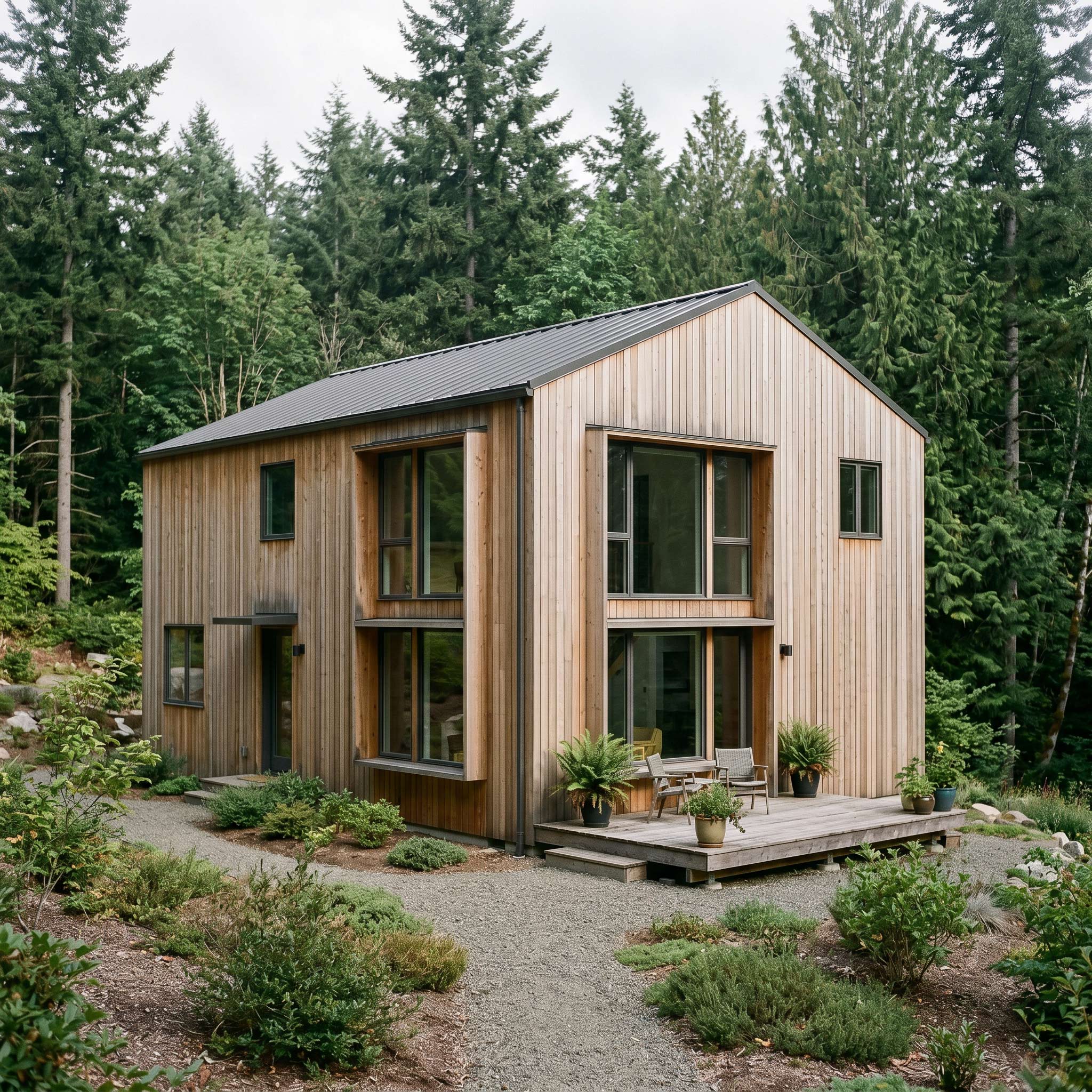
Architecture shaped by climate
Why passive house makes
sense in the Pacific Northwest
Cool, damp winters. Increasing summer heat waves. Rising utility costs.
Homes in this region demand:
- Careful moisture management
- Superior insulation
- Airtight construction
- Thoughtful solar control
- Durable exterior assemblies
Passive House methodology responds directly to these conditions through performance-driven design and precise detailing.
What the numbers mean
(Without the jargon)
A well-executed Passive House can achieve:
- Up to 75–90% reduction in heating energy demand
- Airtightness levels 5–10 times tighter than standard construction
- Heating demand as low as 15 kWh/m² per year
- Significantly reduced carbon emissions
In practical terms, this translates to:
- Stable indoor temperatures year-round
- No cold drafts near windows
- Lower monthly energy costs
- Consistent fresh, filtered air
- Protection against future energy price increases
Performance modeling is introduced early in the design process — not to complicate decisions, but to guide them intentionally.
Investing where it matters
Rather than oversizing mechanical systems, the investment shifts toward:
- High-performance windows
- Continuous insulation
- Thermal bridge-free detailing
- Heat recovery ventilation
- Strategic orientation and shading
These elements may be invisible, but they are what allow a building to perform reliably for decades.
Architectural Expression
+ Environmental Intelligence
Passive House does not dictate architectural style. It informs proportion, window placement, material layering, and envelope precision.
My approach balances:
- Warm, regional material palettes
- Deep roof overhangs for rain protection
- Carefully composed openings for daylight
- Clean detailing that supports airtight construction
Performance and architecture are developed together — never as separate conversations.
The cost conversation
Passive House construction in the Pacific Northwest typically carries a 5–10% premium over conventional methods.
When evaluated over the life of the building:
- Operational energy costs are dramatically reduced
- Mechanical systems are often simplified
- Long-term durability increases
- Resale value trends higher in performance-driven markets
Sustainability should be deliberate and intelligent — not excessive.
Comfort you experience daily
The greatest return on investment is experiential:
- Even temperatures from room to room
- Quiet interiors insulated from weather and noise
- Fresh air without needing to open windows in winter
- Natural daylight without overheating
A high-performance home feels different. Calmer. More stable. More considered.
Is passive house right for you?
You may be well suited for a performance-driven approach if:
- You plan to remain in your home long-term
- You value durability and long-range thinking
- You prefer building once — and building well
- You care about environmental stewardship
- You want architecture aligned with climate reality
Full certification is optional.
Performance-driven design is not.
Let’s build for the
climate we live In
The Pacific Northwest demands architecture that understands rain, light, and seasonal change.
If you are considering:
- A new custom home
- A deep energy retrofit
- A sustainable addition
- A high-performance renovation
I welcome the opportunity to explore what is possible.
I am a Pacific Northwest architect specializing in Passive House and high-performance sustainable homes designed for energy efficiency, long-term durability, and climate-responsive living.